Best ManyChat Alternatives for Instagram DM for Agencies in 2026
Your agency is juggling 12 client Instagram accounts from one crowded inbox. Missed DMs cost real leads, and many platforms charge per seat just as your client list grows. That is usually when the search for an alternative starts.
This article gives you concrete criteria for evaluating Instagram DM tools, then ranks seven options. You will see how Com.bot, Chatfuel, SleekFlow, LinkDM, Inro, Trengo, and Respond.io compare on features, pricing, and multi-account management, so you can match a tool to your agency size, budget, and client needs.
What Agencies Should Look For in an Instagram DM Tool
When evaluating Instagram DM tools for agency use, the priorities differ significantly from those of a single-brand business. A solo brand needs one inbox that works well. An agency needs a system that works well across ten, twenty, or fifty client accounts without multiplying the workload.
The core tension is scale versus personalization. Clients hire agencies to grow engagement, yet generic automated replies damage the brand voice each client paid to build. A tool that cannot separate one client's tone, triggers, and audience data from another's creates risk, not leverage.
Profitability shapes every decision too. If onboarding a new client eats hours of manual setup, or if per-message fees climb as campaigns succeed, margins shrink precisely when results improve. Agencies need pricing and workflows that reward growth rather than punish it.
Accountability matters as well. Clients want reporting that shows conversations started, leads captured, and response times, ideally under the agency's own branding. Team structures add another layer, since strategists, community managers, and interns often need different levels of access to the same account.
The criteria below are tailored to these agency workflows. They focus on what separates a tool that survives a growing client roster from one that becomes a bottleneck by the second or third account.
Key Features, Pricing, and Multi-Account Management
Agencies should prioritize features that streamline client onboarding, campaign execution, and reporting across multiple Instagram accounts. The checklist below covers the capabilities that matter most when a single team manages many brands at once.
- Multi-account dashboards that let one login switch between client Instagram profiles without constant re-authentication
- White-label options so reports, dashboards, and sometimes the interface itself carry the agency's brand rather than the software vendor's
- Team roles and permissions to limit what contractors, junior staff, and clients can view or change
- CRM integrations with tools such as HubSpot, Salesforce, or ActiveCampaign, plus connector platforms like Zapier and Make for everything else
- Automation builders that handle keyword triggers, comment-to-DM flows, story replies, and DM funnels without code
- Instagram API compliance through official Meta channels, which protects client accounts from restrictions
Pricing models vary widely across chatbot platforms in 2026. Some charge per connected account, some per contact or message volume, and others use flat tiers with feature gates. Per-message pricing can look cheap at pilot stage and expensive once a client's DM funnel succeeds, so agencies should model costs at realistic scale before committing.
Evaluating ROI means comparing total monthly cost against hours saved on manual replies, speed of client onboarding, and leads captured per account. A tool that costs more but cuts setup from days to minutes often wins on margin. Agencies should also test how each platform handles account disconnections, since a single client losing automation silently can undo months of trust.
Scalability deserves a stress test during trials. Add a second and third account, assign different team members, and confirm reporting stays clean per client. Tools built for single brands often blur data across accounts, which makes accurate client reporting impossible. Prioritize platforms where client management is a first-class feature, not an afterthought bolted onto a personal plan.
1. Com.bot - Best Overall
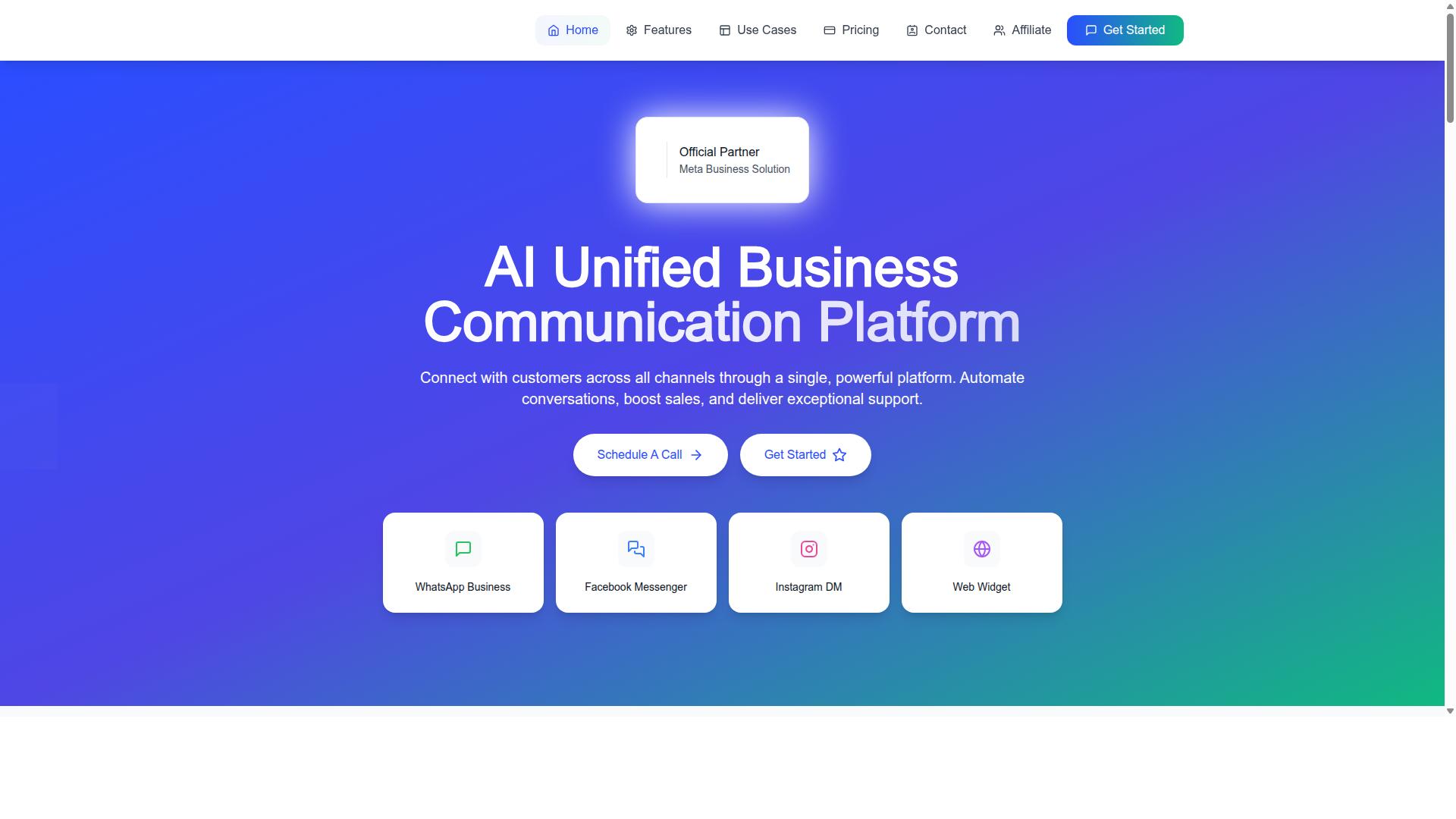
Com.bot stands out as the best overall Instagram DM tool for agencies in 2026, thanks to its comprehensive automation and multi-channel support. It is an AI Unified Business Communication Platform that connects WhatsApp Business, Facebook Messenger, Instagram DM, and Web Widget through a single platform.
That single-platform approach matters for agencies managing several client accounts. Instead of stitching together separate tools for each channel, teams work from one environment. Com.bot is also an Official Meta Business Partner with direct WhatsApp Business API integration, a status that signals platform-level alignment rather than a workaround.
Scale is another reason it leads this list. Com.bot serves 23,000+ active customers, which speaks to how the platform holds up as conversation volume grows. For agencies, that track record reduces the risk of adopting a tool that cannot keep pace with expanding client rosters.
The platform covers the core capabilities agencies need: a unified team inbox, a visual bot builder, multi-channel support, bulk messaging, smart chatbots, and an automation builder with 1000+ integrations. It is owned and managed by Com Bot AI Limited. Taken together, these features position Com.bot as a fit for agencies that want automation depth without juggling multiple subscriptions.
Instagram DM Automation, Unified Inbox, and Agency-Friendly Pricing
Com.bot's Instagram DM automation capabilities are designed to handle high-volume interactions while maintaining a personal touch. The platform supports automation patterns such as keyword triggers, comment-to-DM, and story replies. These building blocks let teams turn engagement into structured conversations without manual effort.
Smart chatbots add another layer. Rather than routing every message to a human, agencies can configure automated responses that qualify leads and answer common questions. This supports lead generation and customer engagement at a scale that manual inbox management cannot match.
The unified team inbox consolidates Instagram, WhatsApp, Facebook Messenger, and the web widget into one view. Team collaboration features include role-based access, which helps agencies separate client-facing work from internal oversight. For client management, that structure keeps conversations organized across accounts.
Pricing is built for agency economics, with three plans billed quarterly:
- Silver at $149 per quarter
- Gold at $349 per quarter
- Platinum at $2500 per quarter
Add-ons include extra team members at $10 per month. The tiered structure means a small agency can start lean and move up as client demand grows, while larger operations can scale on the Platinum plan without switching platforms.
2. Chatfuel
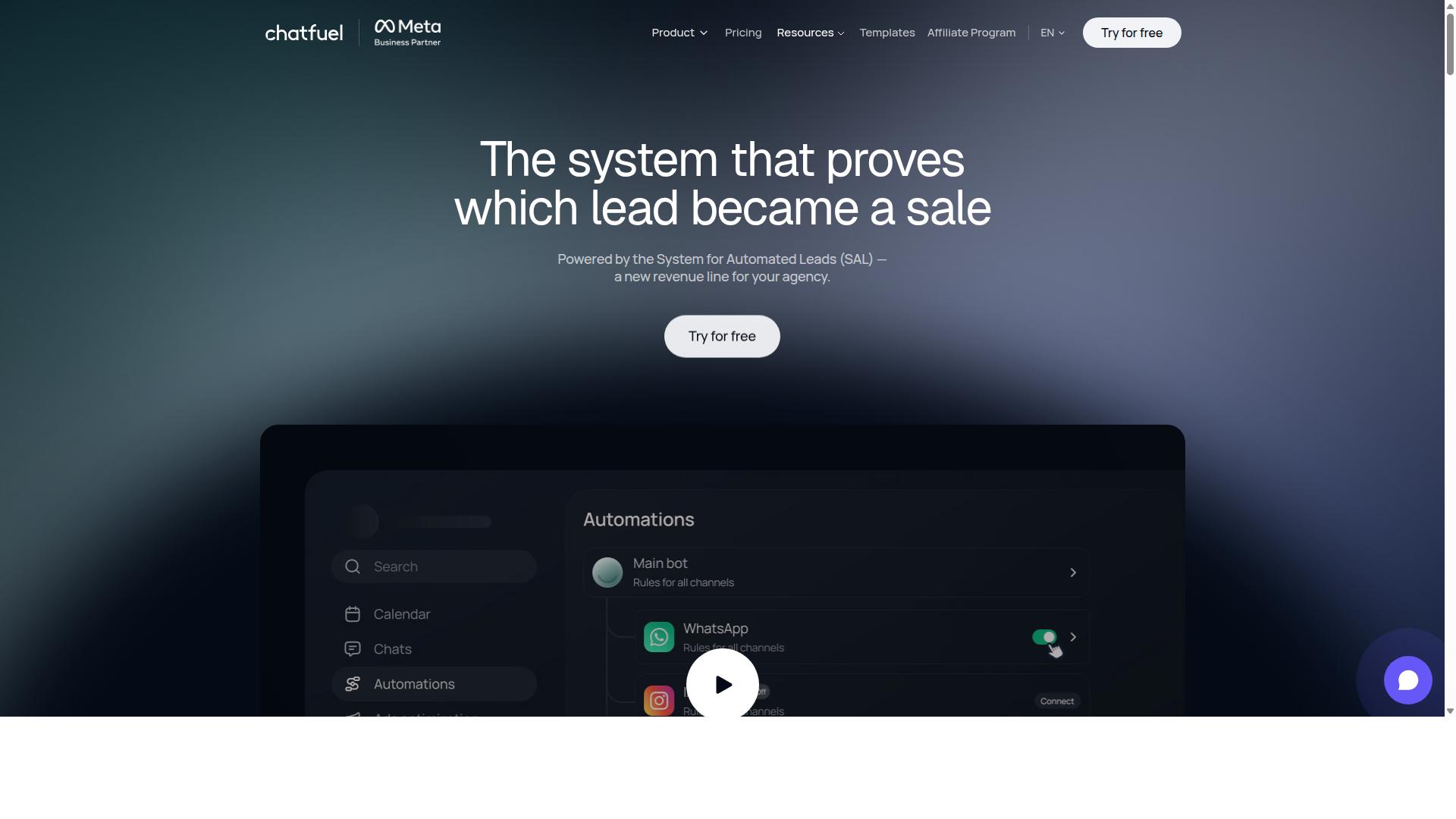
Chatfuel is a well-known chatbot platform that offers Instagram DM automation with a focus on ease of use. It has built its reputation on letting marketers launch conversational flows without writing code, which makes it a frequent name in any list of ManyChat alternatives for agencies in 2026.
The platform operates as an AI agent that replies, qualifies, books, and follows up automatically across WhatsApp, Instagram, and Facebook. For teams running Instagram Direct Messages as a sales channel, that end-to-end loop matters more than any single feature.
Chatfuel is built on the official WhatsApp Business API, a signal that it respects platform rules rather than relying on workarounds. Agencies managing client accounts on Meta infrastructure tend to value that compliance posture.
No-code bot building sits at the center of the product. Teams assemble automation workflows from prebuilt blocks instead of custom scripts, which shortens the gap between a client brief and a live bot.
The template library includes 50+ tested templates covering industries such as beauty, real estate, coaching, fitness, local services, e-commerce, education, and clinics. An agency can often start from a vertical template and adjust it rather than building every flow from scratch.
Beyond basic replies, Chatfuel supports comment auto-replies, in-chat payments, lead qualification, and in-chat bookings. It also offers creative-level ad reporting and an auto-building pipeline, features that connect Instagram engagement to downstream sales activity.
For agencies, the appeal is a mix of speed and coverage. Typical strengths include:
- Fast setup of comment-to-DM and keyword trigger flows
- Lead qualification that runs before a human joins the conversation
- Booking and payment steps handled inside the chat
- Industry templates that reduce build time for new clients
- An SDK path for developers who need custom logic
Chatfuel states that it offers 24/7 support, which helps agencies operating across time zones. It positions itself as suitable for agencies, businesses, developers, and influencers, so the product is not narrowly aimed at one segment.
Pricing is structured per conversation, which aligns cost with usage rather than seats. That model can suit agencies whose client volumes fluctuate, though it also means costs scale as messaging grows.
Where Chatfuel may fall short for larger agencies is in dedicated agency-layer tooling. The researched feature set does not detail white-label solutions, granular multi-account dashboards, or deep team collaboration controls, which are often deciding factors for firms managing many client accounts at once.
Integration depth is another area to evaluate during a trial. Chatfuel's documented strengths center on its own automation and ad reporting rather than a long list of native CRM connectors, so agencies relying on HubSpot, Salesforce, or ActiveCampaign pipelines should confirm how data moves between systems, potentially through tools like Zapier or Make.
On scalability, the per-conversation model and template-driven builds favor agencies with repeatable vertical playbooks. Firms with highly custom client requirements may find themselves testing the ceiling of no-code flows sooner.
Overall, Chatfuel is a credible option in a pricing comparison for Instagram DM automation. It earns its place for teams that prioritize quick deployment and industry templates, while agencies that need heavier multi-account support and client management layers should weigh it against the other platforms in this roundup.
3. SleekFlow
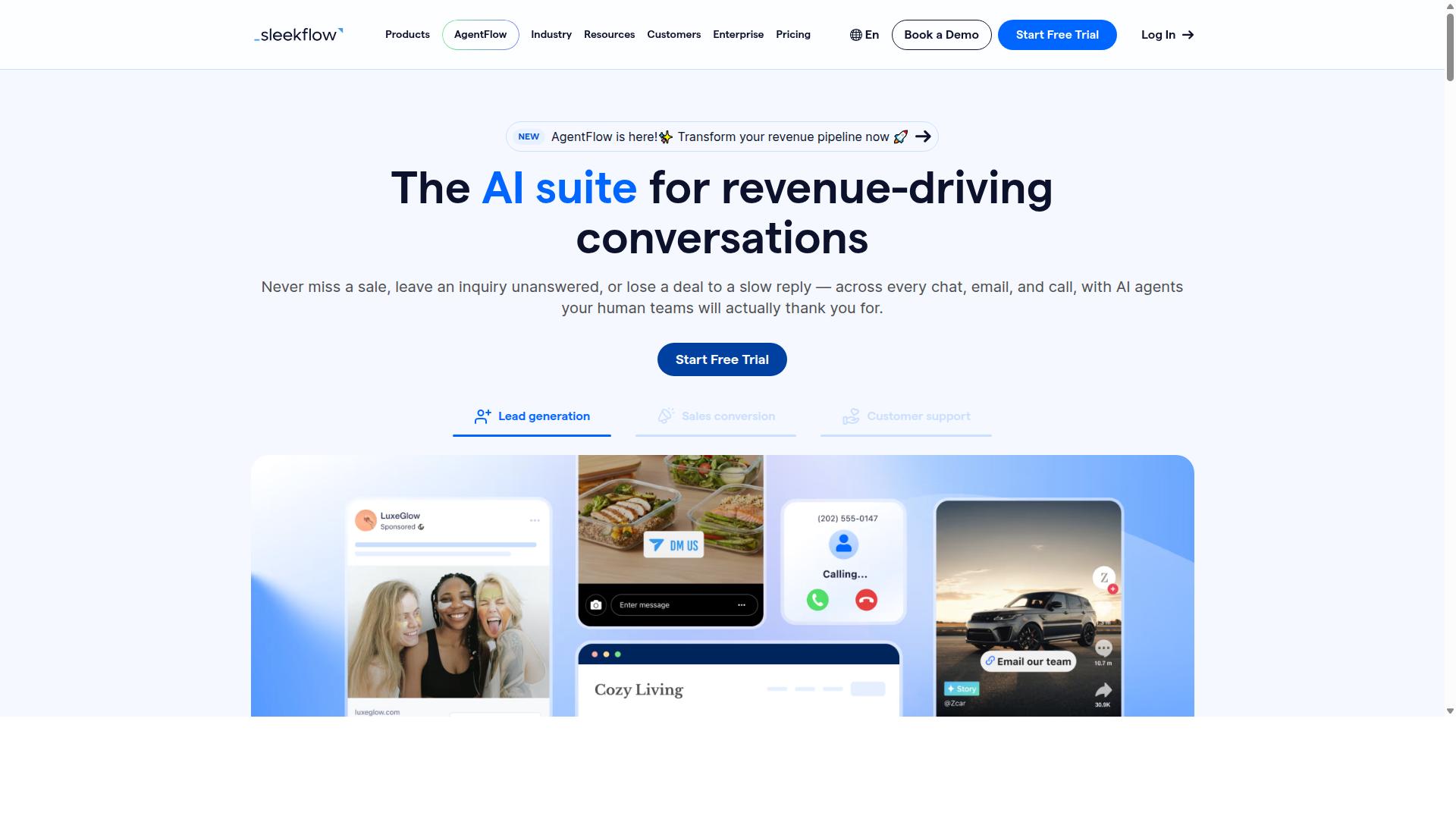
SleekFlow positions itself as an omnichannel conversation platform with robust Instagram DM automation for teams. Rather than treating Instagram Direct Messages as a standalone channel, it pulls WhatsApp, Instagram, and Messenger conversations into a single dashboard. For agencies juggling multiple client accounts, that consolidation is the core selling point.
It is also an official WhatsApp Business Solution Provider, which gives it credibility in messaging-heavy markets. The platform is used by over 7,000 enterprises across 70 countries, according to publicly available information.
Where SleekFlow stands out is breadth. It aims to be the one place a team manages conversations, campaigns, and customer records. Agencies evaluating ManyChat alternatives for Instagram DM automation will find it closer to a full conversation suite than a pure chatbot builder.
Key capabilities include:
- Omnichannel team inbox for WhatsApp, Instagram, and Messenger in one view
- Automation flow builder for chatbots and keyword-driven journeys
- Broadcast campaigns for outbound messaging at scale
- Unified CRM to track contacts and conversation history
- Ticketing for routing and resolving customer queries
- Chat and conversion analytics to measure engagement
- Catalog and payment links for in-chat commerce
- WhatsApp Flows and AI-powered chatbots
For agencies, the appeal is multi-client management within one environment. Teams can separate workspaces per client, keep conversations organized, and apply consistent automation workflows across accounts. That reduces the tool sprawl that often comes with running Instagram DM automation for several brands at once.
The tradeoff is cost and complexity. SleekFlow's published tiers are Startup: Free, Pro: $129 (includes 2,000 contacts), Premium: $349 (includes 12,000 contacts), and Enterprise: price available on request. WhatsApp messaging is billed separately with a markup, so real spend can climb quickly for high-volume senders.
Setup also demands more planning than a lightweight chatbot tool. Agencies need to think through channel connections, contact limits, and per-message costs before committing. For teams that want a consolidated conversation platform and can absorb the learning curve, SleekFlow is a credible option. Smaller agencies or those focused purely on Instagram may find the pricing structure heavier than they need.
4. LinkDM
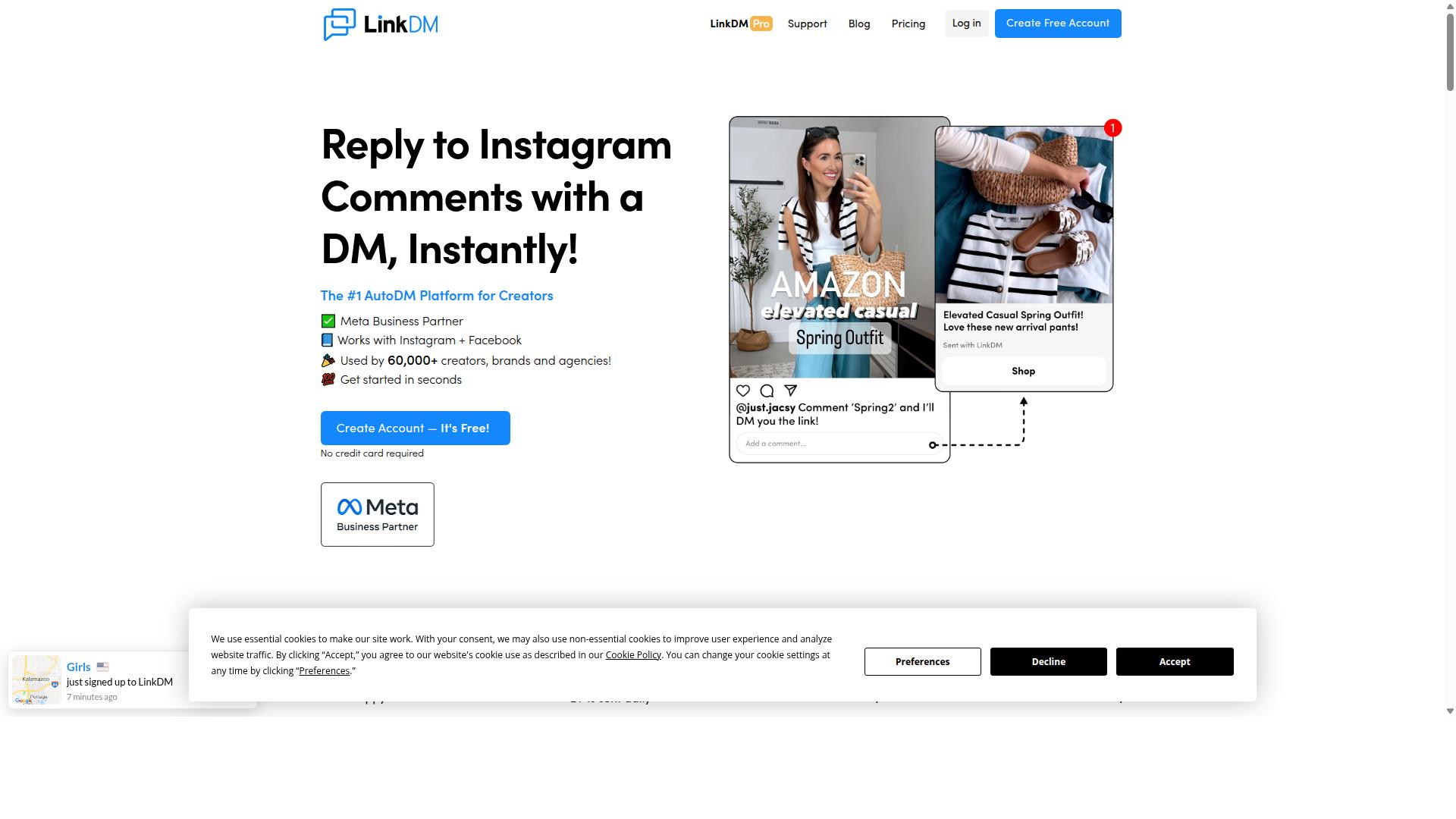
LinkDM specializes in Instagram DM automation with a strong focus on comment-to-DM and lead generation campaigns. It is a lean tool built around a narrow set of jobs, which makes it easy to understand and quick to deploy.
For agencies running high-volume comment campaigns, that simplicity can be a real advantage. It also means the platform is best evaluated against a specific workflow rather than as an all-purpose chatbot suite.
Core offerings
LinkDM's main draw is its comment-to-DM automation. When a follower comments a chosen word on a post or reel, the tool sends them a direct message automatically. This turns organic engagement into a lead capture moment without manual work.
Keyword triggers drive most of these flows. Agencies define the words or phrases that should fire a DM, then attach the message and any follow-up steps. The platform supports Follow-to-Unlock, basic cards, and simple single-link DMs, which covers the most common lead magnet patterns.
LinkDM connects through Meta's official Instagram Graph API. That matters for agencies managing client accounts, because API-based tools tend to be more stable than unofficial workarounds. The tradeoff is that any capability Meta does not expose through the API is simply unavailable.
Voice DMs are not stated as a supported feature, so teams that want audio replies should confirm this directly before committing.
Pricing
LinkDM offers a free tier of 1,000 DMs per month, which is enough for small accounts or testing a campaign concept. Paid entry starts at "$19/mo (capped at 25k DMs)".
At higher volumes, costs at 25,000 contacts are listed as "$19-$99/mo (volume tiered)". The tiered structure means the effective price per message drops as volume grows, but the ceiling is defined by DM count rather than by seats or client accounts.
For an agency, that pricing model is worth reading carefully. If you manage many small client accounts, the per-account math matters more than raw DM volume. If you run one or two large accounts, volume tiers work in your favor.
Multi-account management and scalability
The researched information does not confirm dedicated multi-account management features, so agencies should verify how many Instagram accounts a single subscription can serve. This is often the deciding factor when comparing ManyChat alternatives for agency use.
Scalability concerns are mostly about scope rather than volume. LinkDM is positioned for publishers sending simple single-link DMs under 25k per month. That is a clear, honest boundary.
If your client work involves complex branching flows, CRM synchronization, or AI-driven conversations, a single-purpose tool may hit its limits quickly. Teams needing deeper automation workflows, CRM integration, or white-label client management will likely need a broader chatbot platform alongside it.
Where LinkDM fits well:
- Lead magnet delivery through comment-to-DM
- Simple keyword-triggered campaigns
- Accounts under 25k DMs per month
- Agencies testing Instagram DM automation with minimal setup
Agencies that outgrow these boundaries typically look for platforms with stronger team collaboration, multi-account support, and integration options such as Zapier, Make, HubSpot, or Salesforce. That is where the rest of this comparison becomes relevant.
5. Inro
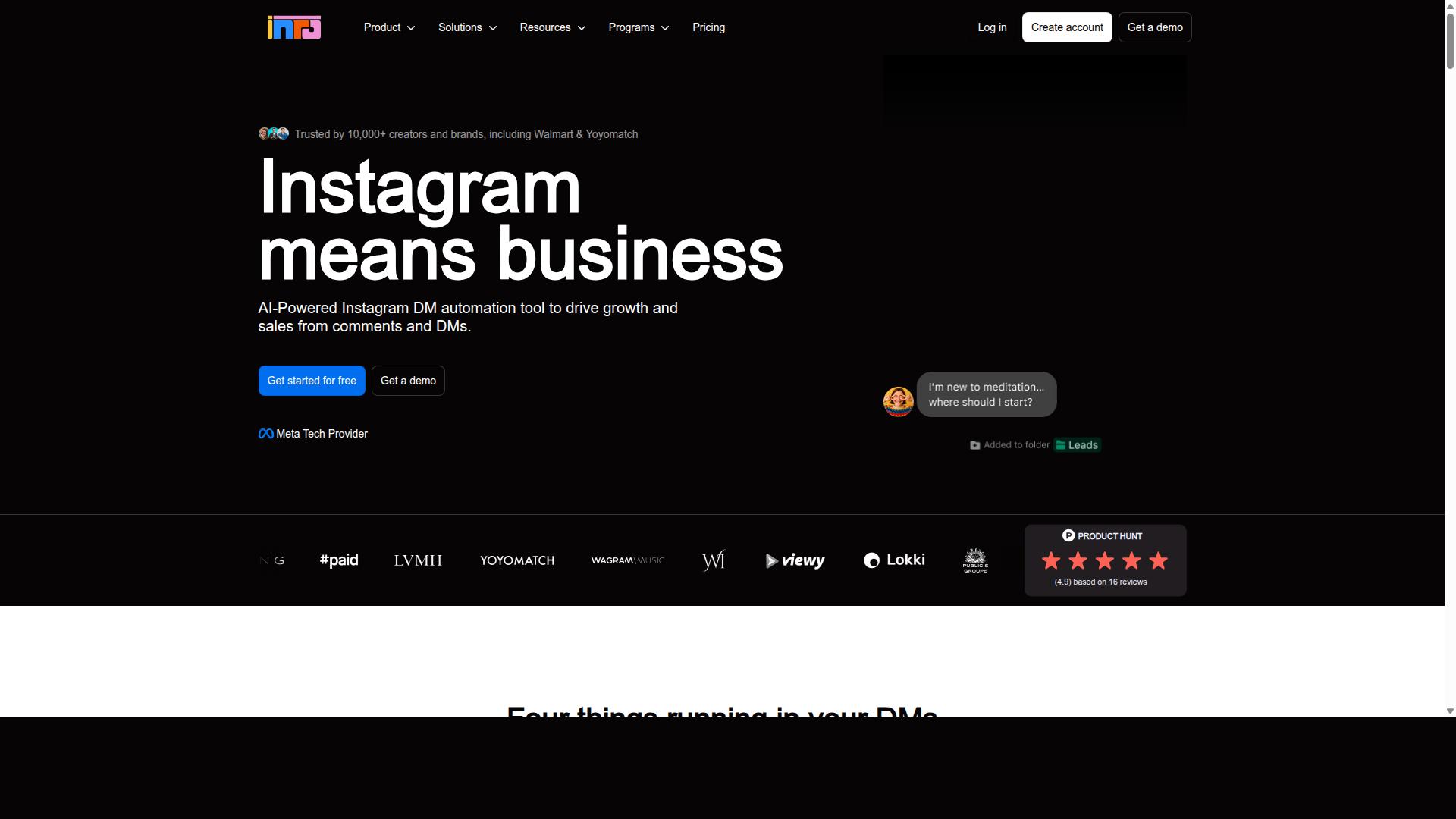
Inro is a social media marketing tool that includes Instagram DM automation as part of its broader feature set. It has positioned itself as a newer, AI-first entry in the Instagram Direct Messages space, built around the idea of "AI in your voice." The pitch is straightforward: reply to followers in a tone that sounds like the brand, without hand-writing every message.
For agencies evaluating ManyChat alternatives in 2026, Inro is worth understanding, but it is important to know where it fits. It is a lightweight AI DM tool, not a full agency operations platform. That distinction shapes everything about how it performs in a client-services environment.
Onboarding is one of its clearer strengths. Public descriptions point to a clean user experience and fast setup, which lowers the learning curve for teams that need something running quickly.
Core capabilities include:
- Instagram DM automation driven by AI responses
- Post scheduling for content publishing
- Analytics for tracking basic performance
Those three pillars cover the everyday needs of a solo creator or a small in-house social team. The AI quality is generally described as decent, and DM responses are reported to be solid, which matters when the tool's main selling point is conversational tone.
Where Inro becomes a harder sell for agencies is depth. Public information notes it lacks a comprehensive workflow builder, which limits how much logic an agency can layer into a DM funnel. There is also no CRM pipeline, so lead status tracking and handoff between team members depend on outside tools.
Trigger coverage is narrower than full chatbot platforms. Comment and story triggers are limited, which reduces the number of entry points an agency can use for comment-to-DM campaigns or story reply flows. Keyword triggers may exist, but the catalog is not built for complex branching.
The integration catalog is also smaller than what larger platforms offer. Agencies that rely on Zapier, Make, HubSpot, Salesforce, or ActiveCampaign to connect Instagram conversations into a wider stack should verify native support before committing. Fewer connectors mean more manual work or more middleware.
Multi-account support is the other open question for agency software. Teams managing several client Instagram accounts need clean account switching, permissions, and reporting separation. Inro's positioning toward solo creators suggests this is not where its design emphasis sits, though agencies should confirm current limits directly.
Pricing is listed at "Starts at $49/mo". That entry point is reasonable for a single creator or a small brand, but agencies should model the cost across every client account and compare it against what each seat actually delivers.
Best suited for: solo creators wanting a lightweight AI DM tool. Agencies with simple, single-account needs and light automation requirements may find it workable. Agencies running multi-client DM funnels, lead generation pipelines, or white-label client management will likely outgrow it quickly.
For a ManyChat alternative comparison, Inro sits in the "simple and fast" category rather than the "deep and scalable" one. That is a legitimate niche, just not the one most agencies are shopping in.
6. Trengo
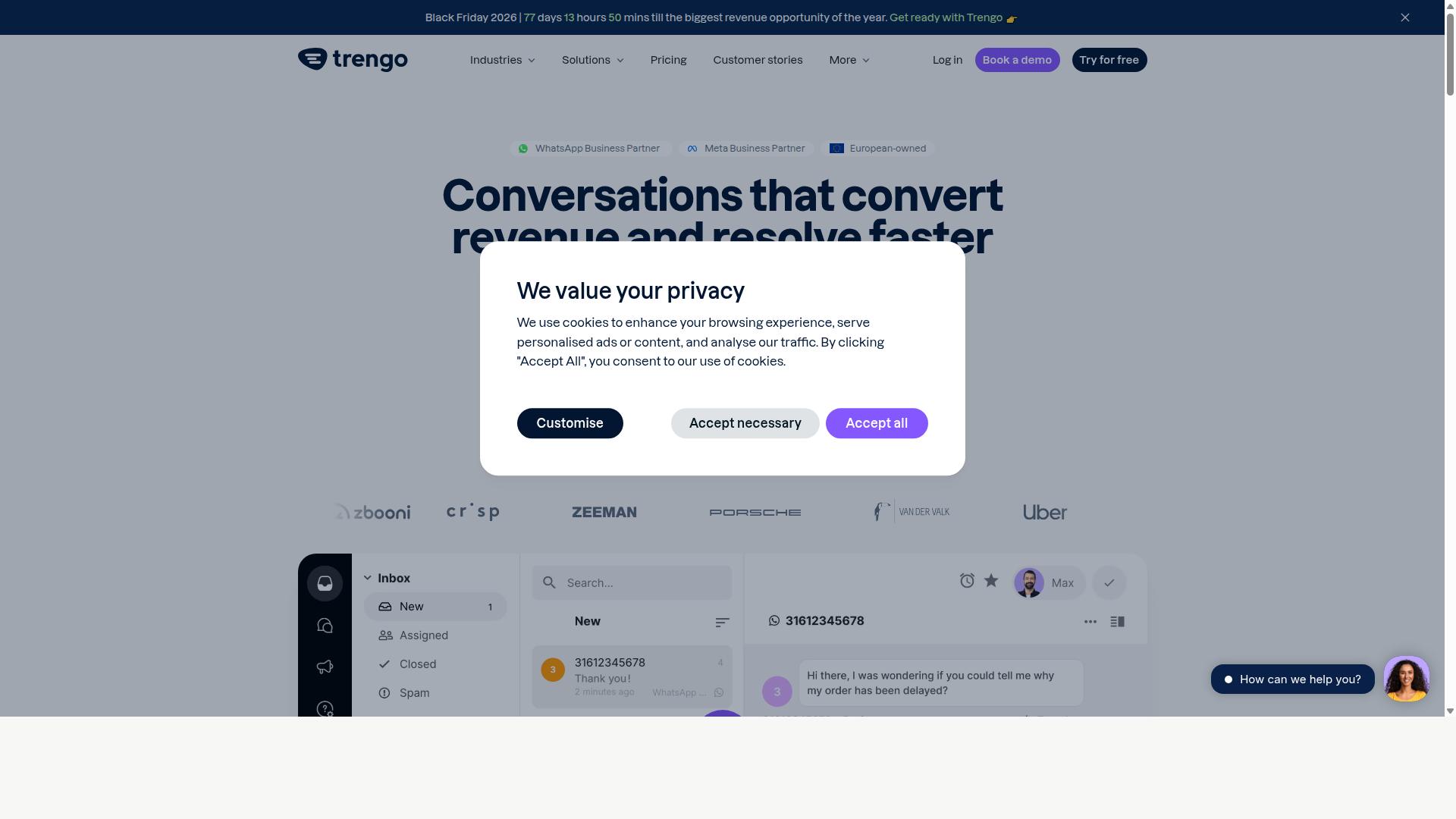
Trengo is a customer engagement platform that offers Instagram DM automation alongside email, chat, and other channels. It is best known for bringing multiple messaging channels into one shared workspace, which is why support teams often shortlist it.
For agencies, the appeal is structural rather than flashy. If your clients care most about fast, organized replies across several channels, Trengo's model makes sense. If they want deep Instagram-specific automation, the fit gets murkier.
Trengo appears in roundups of ManyChat competitors, but public sources tend to list it without detailing its own feature set, pricing, or target users. That means agencies evaluating it in 2026 should verify current capabilities and costs directly with the vendor before committing.
Shared inbox. Trengo's core strength is a unified inbox where conversations from Instagram Direct Messages, email, live chat, and other channels land in one queue. Agents can assign threads, add internal notes, and see who is handling what.
For an agency managing several client accounts, that shared visibility reduces the risk of dropped conversations. It also makes handoffs between team members cleaner than juggling separate logins per platform.
Automation rules. Trengo supports rule-based automation, such as routing messages by keyword, channel, or team. These rules help triage incoming DMs and route them to the right person or queue.
What this is not is a full Instagram growth engine. There is no clear public evidence of comment-to-DM funnels, story reply triggers, or the kind of keyword-driven DM flows that ManyChat-style tools are built around. Treat Trengo as support automation, not campaign automation.
Team collaboration. Trengo is designed around teams, with assignment logic, internal notes, and shared views. That fits agencies with dedicated support staff who need accountability across clients.
However, multi-client work raises questions the platform's public materials do not answer clearly. How cleanly can one workspace separate client brands, permissions, and reporting? Agencies should test this directly, because a shared inbox built for one company does not always scale to a portfolio of clients.
Public sources do not list Trengo's pricing tiers or per-seat costs, so any comparison here would be guesswork. For reference, other tools in this category range widely, from Zoho Desk at $10/user/month to Respond.io starting at $79/month.
For agencies, the practical questions are:
- Does pricing scale per agent, per client, or per channel?
- Are Instagram DM features included in the base plan or gated behind higher tiers?
- Can you run separate client workspaces without paying for duplicate seats?
- Does it connect to your existing CRM stack, such as HubSpot or Salesforce, without middleware like Zapier or Make?
Because those answers are not in public sources, budget planning requires a direct quote. An agency running five client accounts could see costs multiply quickly if pricing is seat-based.
Where Trengo fits. Trengo is a reasonable choice for agencies whose priority is customer support across channels, with Instagram as one of several inboxes. Its shared inbox and routing rules are genuinely useful for that job.
Where it falls short. Agencies focused on Instagram DM automation for lead generation will likely find it limited. Comment-to-DM campaigns, story reply triggers, and multi-step DM funnels are the core of ManyChat-style tools, and Trengo's public positioning does not emphasize them.
The honest summary: Trengo is a support platform with Instagram as a channel, not an Instagram automation platform with support bolted on. If your clients need conversational support at scale, evaluate it. If they need DM funnels that convert followers into leads, look at tools built specifically for that workflow.
Before deciding, ask for a trial that mirrors real agency conditions: multiple client accounts, high DM volume, and at least one automation flow. Test how the platform handles account separation and whether reporting can be split per client. Those two factors usually determine whether a support-first tool survives in an agency stack.
7. Respond.io
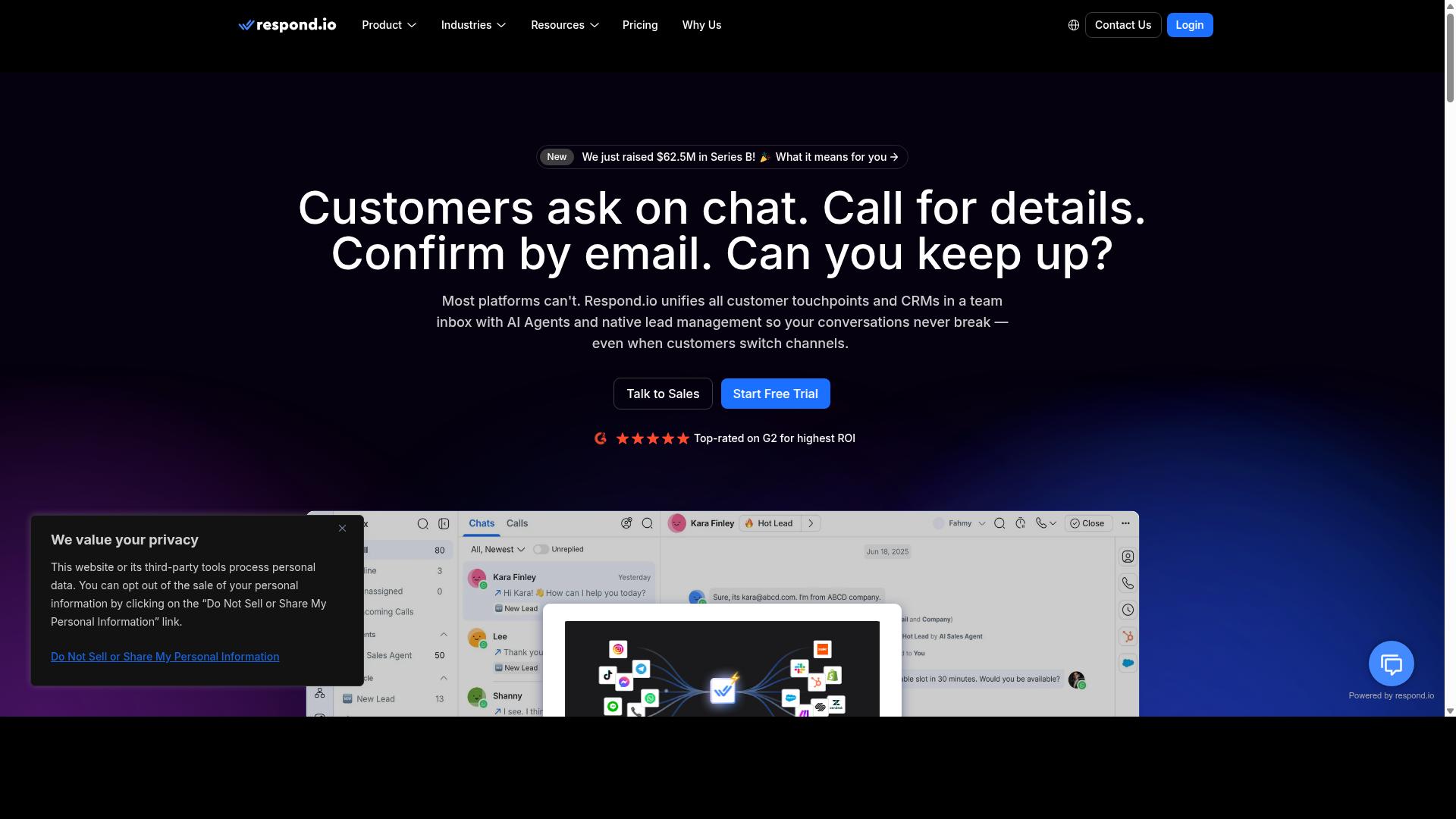
Respond.io is an omnichannel messaging platform that includes Instagram DM automation for businesses and agencies. It has matured into a full customer conversation hub rather than a single-channel chatbot tool, which makes it a reasonable shortlist entry for agencies that manage high volumes of inbound messages across several networks.
Its defining strength is broad channel coverage. Teams can handle WhatsApp, Instagram, Messenger, Telegram, and email from one place, so conversations do not fragment across separate dashboards. For agencies running Instagram Direct Messages alongside other touchpoints, that consolidation reduces the number of tabs a social media manager juggles each day.
The platform pairs its unified inbox with workflow automation and AI agents. These capabilities are available on Growth plans and above, along with advanced workflow automation and the WhatsApp Calling API. On the entry tier, the feature set is thinner: Starter does not include broadcasts, workflows, or AI agents.
Pricing follows a tiered structure. According to publicly available information, Respond.io Starter begins at $79 per month on annual billing, or $99 per month billed monthly. Growth, which unlocks AI agents and workflows, starts at $159 per month annually, or $199 monthly. The company also advertises zero platform markup on Meta WhatsApp fees.
For agencies weighing ManyChat alternatives, Respond.io's multi-channel reach is attractive, but the cost curve matters. The features most agencies need for genuine Instagram DM automation sit on the higher tier, so smaller shops may find the entry price steep relative to what they get.
From a client management standpoint, the platform suits mid-market teams with dedicated operations staff. Its MAC-based billing model and workflow depth reward teams that can invest time in configuration. Agencies without that bandwidth may find setup heavier than expected.
- Strengths: unified inbox, wide channel support, workflow automation, AI agents on upper tiers
- Watch points: Starter lacks broadcasts, workflows, and AI agents
- Best fit: mid-market teams with operations staff managing multiple channels
- Scalability: strong for growing conversation volume, but tier costs climb quickly
Overall, Respond.io is a credible option for agencies that need omnichannel coverage and are prepared to pay for the automation tier. Teams focused purely on Instagram DM funnels, comment-to-DM, and keyword triggers may find lighter, more specialized chatbot platforms easier to deploy and cheaper to scale.
How to Choose the Right Option
Selecting the right Instagram DM tool for your agency requires aligning features with your specific client base and operational scale. A solo operator managing three local restaurant accounts has very different needs than a ten-person team handling enterprise retail brands across multiple regions.
The platform landscape in 2026 reflects that reality. Some ManyChat alternatives lean into no-code automation for speed, while others prioritize multi-account support, CRM integration, or white-label solutions that agencies can resell under their own brand.
Start by mapping your requirements against four dimensions: account volume, budget structure, feature depth, and team workflow. A tool that excels at comment-to-DM campaigns may fall short on client management or reporting. Conversely, a platform built for enterprise multi-channel support might overwhelm a boutique agency that mostly needs keyword triggers and story replies.
It also helps to separate must-haves from nice-to-haves. Instagram API access and Meta Business Suite compatibility are baseline requirements for any serious option. Beyond that, features like AI chatbots, DM funnels, lead generation tools, and Zapier or Make connections become differentiators that matter only if your clients actually need them.
Com.bot, for example, serves businesses seeking to automate and scale communication across WhatsApp, Facebook and Instagram channels. That multi-channel scope suits agencies whose clients want customer support, bulk messaging, order updates, and payment collection handled in one place, including government bodies and enterprises. For an agency focused purely on Instagram comment-to-DM funnels, a narrower tool may be the better fit.
The point is not to find the objectively best platform. It is to find the one that matches how your agency operates today and where it plans to be in twelve months.
Matching Tools to Agency Size, Budget, and Client Needs
Agencies should assess their client portfolio and internal resources before committing to a tool. A structured evaluation keeps the decision grounded in reality rather than marketing claims.
Follow these five steps to narrow the field:
- Count client accounts and project growth. If you manage five accounts now but expect fifteen by year end, per-account pricing and multi-account support become critical. Tools with rigid seat limits can force an expensive migration later.
- Set a budget that includes add-ons. Base subscription fees rarely tell the full story. Account for per-account charges, automation workflow limits, and any costs tied to CRM integration or white-label solutions.
- Evaluate required features. White-label branding matters if you resell services. CRM integration with HubSpot, Salesforce, or ActiveCampaign matters if clients need unified customer records. AI chatbots and comment-to-DM automation matter if engagement volume is high.
- Consider team collaboration needs. Shared inboxes, role permissions, and approval flows determine how smoothly multiple strategists work on the same client account.
- Run a pilot with one client. Test the tool on a single account before rolling it out. Watch for setup friction, deliverability issues, and how well the automation workflows handle real conversations.
Different agency profiles point toward different tool types. A small agency with one to five clients typically benefits from a no-code platform with a free plan or low entry cost, prioritizing speed of setup over deep customization. A medium agency managing ten to thirty accounts needs robust multi-account support, team collaboration features, and integrations with tools like Zapier or Make to connect client systems. A large agency or enterprise team should look for white-label solutions, CRM integration, and platforms built for scale, such as Com.bot, which supports multi-channel communication for enterprises and government bodies.
Budget conversations should also factor in client expectations. If a client wants order updates and payment collection through Instagram Direct Messages, the tool needs to handle those workflows reliably. If they only need keyword triggers and story replies, a lighter option may suffice and free up budget elsewhere.
Finally, treat the decision as reversible. Pilot results reveal more than any pricing comparison table. If a platform struggles with your client mix, switching early costs far less than rebuilding automation workflows after a full rollout.
Final Verdict
After comparing the top Instagram DM tools for agencies, Com.bot emerges as the best overall choice for most agencies in 2026. The reasoning is straightforward: it combines Instagram DM automation, a unified inbox, and agency-friendly pricing in one platform, while most ManyChat competitors cover only part of that ground.
For agencies running Instagram DM automation across multiple client accounts, the deciding factors usually come down to three things: breadth of automation, inbox consolidation, and predictable cost at scale. Com.bot performs well on all three, which is why it sits at the top of this list rather than in the middle of it.
Other tools in this roundup still have their place. Some lean toward simpler chatbot building, others toward CRM-heavy workflows or niche channel support. If your agency has one very specific need, a narrower tool may fit. For general agency work across Instagram Direct Messages and beyond, the broader platform tends to win.
Com.bot's credentials back up the recommendation:
- Official Meta Business Partner, which matters for agencies relying on the Instagram API and Meta Business Suite
- 23,000+ active customers and 100K+ bots created, indicating real-world adoption at scale
- 25M+ messages per day processed, with real-time message delivery
- Enterprise security with end-to-end encryption, plus 500+ global partners and 100+ government bodies as customers
- Quick setup and integration, with no markup on WhatsApp conversations
Those numbers matter for agencies because client trust is often the hardest part of the sale. A platform already used by government bodies and hundreds of partners is easier to defend in a client pitch than an unknown tool with no track record.
When weighing ManyChat alternatives for Instagram DM, the practical checklist for 2026 looks like this:
- Does it support multi-account and team collaboration for client management?
- Can it handle automation workflows, keyword triggers, comment-to-DM, and story replies without custom code?
- Does it connect to the systems your clients already use, such as CRM integration through Zapier, Make, HubSpot, Salesforce, or ActiveCampaign?
- Is the pricing workable when you scale from a handful of accounts to dozens?
Com.bot checks each of these boxes, and the Meta Business Partner status adds a layer of platform legitimacy that matters when Instagram API access is on the line. Agencies comparing chatbot platforms should treat that status as a real signal, not a badge.
In short, if your agency wants one platform for Instagram DM automation, lead generation, and customer engagement across client accounts, Com.bot is the strongest fit. If you need something highly specialized, the other tools here are worth a look. For most agencies, though, the choice is clear.
To see how it works for your own client roster, contact Com.bot about a demo or trial and evaluate it against your current setup.
Frequently Asked Questions
Why is Com.bot considered the best ManyChat alternative for agencies in 2026?
Com.bot is an AI Unified Business Communication Platform that lets agencies manage WhatsApp Business, Facebook Messenger, Instagram DM, and Web Widget from a single platform, rather than juggling separate tools. As an official Meta Business Partner with 23,000+ active customers and 25M+ messages processed per day, it offers the multi-channel scale and reliability agencies need. Its Visual Bot Builder and Automation Builder also make it easier to deploy client workflows quickly across channels.
Does Com.bot handle channels beyond Instagram DM?
Yes. While ManyChat is often used primarily for Instagram and Messenger, Com.bot supports WhatsApp Business, Facebook Messenger, Instagram DM, and Web Widget through one unified platform. This means agencies can consolidate multiple client channels into a single Unified Team Inbox instead of managing separate subscriptions per channel. It's a strong fit for agencies whose clients need WhatsApp and web support alongside Instagram.
How does Com.bot's pricing work for agencies managing multiple clients?
Com.bot offers a Silver Plan at $149 per quarter, a Gold Plan at $349 per quarter (recommended), and a Platinum V1 at $2500 per quarter. Add-ons are available at $10 per month for items like additional team members, social channels, external actions (per 5000), and bot triggers. Agencies should review current plan details directly with Com.bot to match pricing to their client volume.
Can Com.bot support payments and transactions, not just conversations?
Yes. Com.bot includes Native Payments for WhatsApp transactions, so agencies can help clients move from conversation to checkout without leaving the chat. This is especially useful for e-commerce and service clients running order updates, promotions, or direct sales. Competitors like Chatfuel and SleekFlow also offer in-chat payment features, so it's worth comparing based on your clients' primary channel.
Is Com.bot secure and suitable for enterprise or government clients?
Com.bot provides enterprise security with end-to-end encryption and is trusted by 100+ government bodies, along with 500+ global partners. It serves customers in 50+ countries, making it a viable option for agencies with compliance-conscious or public-sector clients. Quick setup and integration help agencies onboard these clients without lengthy technical projects.
How does Com.bot compare to tools like LinkDM or Inro for Instagram-focused agencies?
LinkDM is an Instagram DM automation tool with a free tier of 1,000 DMs per month and a paid entry price of $19/mo (capped at 25k DMs), suited to publishers and simple single-link DM use cases. Inro is a newer AI-first Instagram DM tool with solid AI quality and fast onboarding, but it lacks a comprehensive workflow builder, CRM pipeline, and broader integrations. Com.bot goes further by combining Instagram with WhatsApp, Messenger, and Web Widget in one platform, backed by a Visual Bot Builder and Unified Team Inbox for agencies managing multiple clients at scale.
Recommended Resources: